Showing posts with label prioritization. Show all posts

Wednesday, May 28, 2014

Adjusting for differences in wait time target and actual waited time (Scaling or Indexing)

Our job is relatively easy if we have only one queue with the same target wait time for all . We always serve the person with the longest wait. However, in order to uphold the equity principle, we need to have different wait time targets based on the need. If we have 30 individuals waiting for service and if they are distributed across 5 different target time frames, it would be difficult for a human mind to identify who needs to go first while considering equity, equality and fairness. In this case, we need to interpret (adjust) wait times in light of the patient's priority determined by the wait time target. This is called scaling or indexing.

In the example below, there are 12 people waiting for service. Their current wait times and their target wait times are presented. The question is who should go next. The longest waiting person have been there for 56 minutes (case numbers provided as identifiers not for ranking). Even with 12 people, we need to find a method to identify who should go first. Who do you think should go first?

Case Number Waited Time (min) Wait Time Target (min)
1 16 5
2 26 10
3 15 20
4 20 30
5 53 45
6 11 10
7 8 30
8 56 20
9 43 45
10 18 5
11 45 20
12 33 20

If we purely use First In First Out principle, we can reorder based on their wait time and case #8 has the longest wait time (first in) should go first. But the need or severity of case #8 is different than the need of case #10. It is identified in the target wait time that the case #10 should get service within 5 minutes while the case #8 should get service within 20 minutes. Both cases are above their wait time target, case #8 by 36 minutes and case #10 by 13 minutes. It looks like it is justified that case #8 should receive the service first because s/he waited the longest and also it has the most minutes above its target. However, we can only be sure of our selection between the patients where the wait time targets is same. Certainly between the cases #8, 11, 12, and 3, the case #8 should receive the service first because it waited the longest. But how can we compare the rest to #8?

Case Number Waited Time (min) Wait Time Target (min)
8 56 20
5 53 45
11 45 20
9 43 45
12 33 20
2 26 10
4 20 30
10 18 5
1 16 5
3 15 20
6 11 10
7 8 30

In order to ensure equity and fairness, we need to use a system to select the person based on the considerations of need and wait time, where scaling or indexing is useful.

Scaling is adjusting the wait time of an individual based on their need. Indexing is the same concept but interprets wait time based on the wait time target. The theory behind both concepts is the same.

What is the value of each time unit for the individual in comparison to others'. If the maximum wait time target is 45 minutes, each minute is 9 times more valuable (or important) for a patient with 5 minute wait time target. In scaling, we multiply each waited minute with 9 for the people with 5 minute wait time target and 3 for the people with 15 minute wait time target. In this case, case #10 would have a scaled (or adjusted) wait time of 162 minutes (18 x 9).

Similarly in indexing we divide the wait time by the wait time target. This will give us the length of wait as a ratio of the wait time target. This is probably easier to understand and, more importantly, easier to explain. Table below show the order of recommended service order for people on the waitlist based on the indexing methodology. Case #10 and #1 climbed to the top of the list.

Case Number Waited Time (min) Wait Time Target (min) Waited Time Indexed to Target
10 18 5 3.6
1 16 5 3.2
8 56 20 2.8
2 26 10 2.6
11 45 20 2.3
12 33 20 1.7
5 53 45 1.2
6 11 10 1.1
9 43 45 1.0
3 15 20 0.8
4 20 30 0.7
7 8 30 0.3

With scaling or indexing, we eliminated differences between the wait time targets and waited time, and brought all cases to the same level. We can now use the Queue Discipline Ratio (explained in the previous blog entry) effectively for all cases. We don't have several distributions with different wait times. In the indexing model, 1 will always represents the target. We can divide the average indexed value for people who received their service with the average indexed value for people who are currently waiting. Our objective is to achieve the third graph for equitable and fair delivery of service (when there is a waitlist).


Friday, May 16, 2014

Prioritization and Queue Discipline

Prioritization and Queue Discipline

In the previous post, I finished with the discussion regarding the prioritization and queue discipline and argued that the service needs to be provided equitably, equally and fairly. 

Equitable service delivery requires giving a higher priority for people who has a higher need for service. Person who is unable to walk should get the hip surgery earlier than a person who is able to walk. The quality of life of the person who can't walk has deteriorated more than the one who can walk. In order to identify who has the most need, a prioritization method is required. The prioritization method needs to consider several variables, such as current status of illness, speed of disease progression, the impact of the disease, and social factors. It would be ideal to find tools that can provide an objective assessment of the variable(s) but it is not likely to find one for all possible problems. Here are some examples. 

 Factor
 Example
Current Status
A person who is unable to walk and waiting for surgery can have priority over a person who can walk.
Speed of disease progression
Of the two people who has Parkinson's, the person whose disease progresses faster can have the deep brain stimulator earlier.
Impact of the disease 
(life or limb)
A person who has cancer should receive services earlier because the delay could result in loss of life. A person who has malignant melanoma should receive services earlier than a person with spinocellular carcinoma because maligant melanoma has a higher potential for spread.
Social factors
 Among two people who have the same above factors, a person who is taking care of his/her elderly partner can access the services earlier.

The weights of these factors in determining priority might be different but, at the end, a priority must be given to each individual. Ideally, individuals should be able to compare their priority against the others' on the waitlist. Having transparency of the waitlists satisfies the need for fairness. 

Equal access to services means a person with a particular need should access the services in the same time frame across service providers. For example, if there are five outpatient clinics of a hospital (or five physicians in the practice), all persons who have the same priority should have same average wait time for the services. This ensures that other conditions, such as  location, culture, race, language, income, employment, etc. are not factors in accessing the services. 

Fairness means you access the services based on your priority and the time that you waited must count for something. You would not wait endlessly for a service and pushed constantly to the end of the queue because people with more urgent conditions arrive. However, this may happen in waitlist management for the following reasons.  
  1. Either more urgent cases come (who has the same priority but due to factors that are not captured in the priority) and bump the cases who are on the list to the end of the list.
  2. People who are waiting cannot get their turn when called and they continue waiting. For example, for surgical waitlist, when the patient was given a surgery date and they can't accept it because they are recovering from another ailment, or they have planned to go somewhere, etc.
  3. There are external forces to encourage selecting patients who waited less. When there is performance measure of percent served within their target wait time and it is calculated based on people who received their service, service provider may inclined to provide service to people who are not above their wait time target first in order to ensure their performance is high.
  4. Lastly, as human brain cannot process data easily, we tend to remember the patients that we have seen recently and tend to engage in discussion with them and provide service to them earlier. People who were waiting for a long time continue to wait.
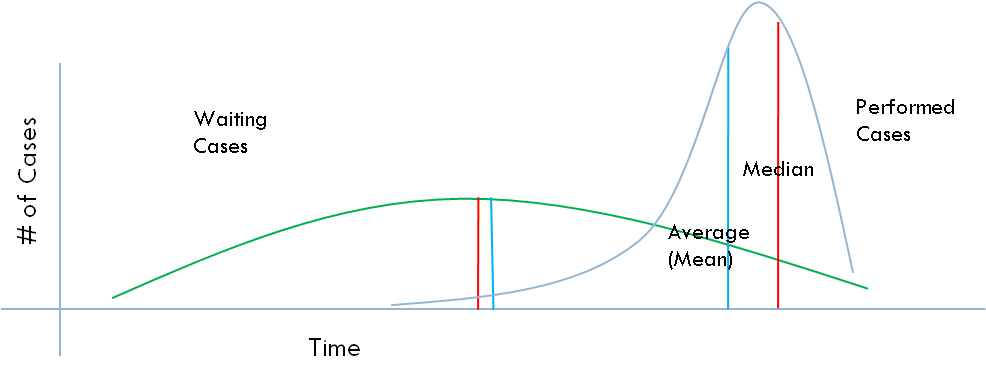
How does the distribution of cases look like against their target, if above factors influence the decision to select patients/customers from the list? For the sake of argument, lets call this First-In- Last-Out (FILO).


People who receive the service receive (above graph performed cases indicating that the patients received their surgery) significantly earlier than the cases waiting during the same time period.

If we randomly select the cases from the waitlist, sometimes we will select a patient that just started waiting and sometimes a patient that has the longest wait time. The distribution will look like a normal distribution. Let's call this random selection (RS)

In this case, eveybody on the waitlist has an equal chance of being picked at any point. The average wait time for performed cases and the waiting cases would be exactly the same (or close).

We get the person who waited the longest from the end of the queue (in-turn). This uses the First-In-First-Out (FIFO) principle.


In this graph, the wait time for the cases waiting at any time is shorter than the cases that received their service. There may be some cases that receive their services earlier but this is certainly not the norm. I don't know which queue among the above three you would like to be in but I certainly prefer the last one.

Based on this view, the IRMACS at the Simon Fraser University (http://www.irmacs.sfu.ca/) came up with a basic indicator. Let's call it Queue Discipline Ratio. It is simply the division of average wait time for performed (or people who received their service) cases by the average wait time for the waiting cases. Random selection will give you a number around 1. The higher the number the more closer the queue discipline to FIFO.

This is quite easy to implement if we have only one queue without differing priorities. What if we have several priorities, can we actually use this?  Next post will cover this. Here is an example.

Blue lines are the cases performed (or received their service) and red lines are the cases still waiting with a particular priority. How can we achieve, and track, queue discipline for this waitlist?